
Adele Karmazyn: The Art of Being Out of Time
By Greg McGee
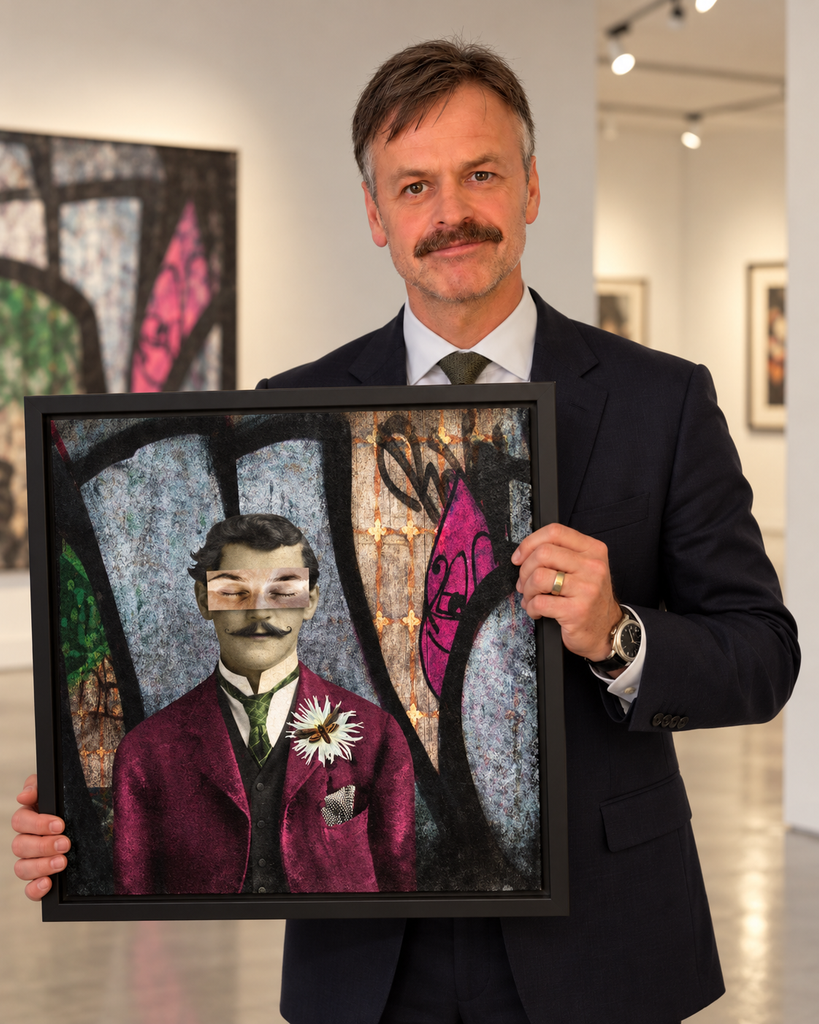
Emily Dickinson, Victorian photography and the strange beauty of worlds that refuse to stay in the past.
Great art has a peculiar relationship with time. It belongs to the moment in which it was made, yet the finest examples somehow escape it. The poetry of Shakespeare, Emily Dickinson and John Clare remains alive not simply because it has survived, but because it continues to speak with an immediacy that defies the centuries separating us from its creation.
There is something almost supernatural about this. A poem written hundreds of years ago can still unsettle, console or astonish. Its language may be rooted in another age, its circumstances almost entirely vanished, yet its emotional force remains intact. We recognise something of ourselves in the words of someone long dead. Time, for a moment, loses its authority.
Dickinson understood this better than most. “Behind Me — dips Eternity,” she wrote, compressing an almost unimaginable expanse into five extraordinary words. John Clare, in An Invite to Eternity, approached the same mystery from another direction, while Shakespeare's sonnets return obsessively to the struggle between beauty, mortality and the passing years.
Perhaps it is no coincidence that so much enduring art concerns itself with eternity. There is an intriguing symmetry in the idea that an artist might achieve a measure of timelessness by making time itself the subject.
The visual arts offer equally compelling examples, and the work of Adele Karmazyn occupies a particularly fascinating place within this tradition.
Karmazyn begins with the past, quite literally. Her raw materials are predominantly nineteenth-century photographs: portraits of people who once stood before the camera in their finest clothes, solemn and self-conscious, unaware that their images might one day find themselves inhabiting entirely different worlds.

These photographs possess their own melancholy. The faces are familiar in their humanity but remote in their circumstances. Their owners have disappeared, their names often forgotten, their lives reduced to a fleeting encounter between light, chemistry and photographic paper.
Karmazyn, however, refuses to leave them there.
Through an intricate process of digital layering, she rescues these figures from their historical surroundings and introduces them to landscapes that are whimsical, surreal and frequently mischievous. Victorian respectability collides with contemporary graffiti. Stiff collars and elaborate dresses inhabit environments that their original wearers could scarcely have imagined.
The results are wonderfully disorientating.

There is something distinctly steampunk about Karmazyn's imagination, although the term hardly does justice to the sophistication of her compositions. Her pictures possess the narrative curiosity of Victorian fiction, the visual wit of collage and the occasional delicious absurdity of a dream. They are at once nostalgic and contemporary, romantic and faintly subversive.
Crucially, the humour never overwhelms the humanity of the original photograph. These are not merely antique figures recruited for a visual joke. Karmazyn gives them new lives, new surroundings and, in doing so, a curious kind of afterlife.

Her process is painstaking. Individual compositions can involve more than forty digital layers, each carefully assembled to establish a convincing world from elements that have no obvious business sharing the same space. What appears effortless is the result of considerable technical precision and an instinctive understanding of how images communicate across historical boundaries.
As Karmazyn explains:
“I collect imagery all the time. Every path I take, everywhere I look I see material I can use. Sometimes I capture it in my mind, sometimes with my camera. My work involves scanning 19th century photographs of which I have a growing collection. With these I intertwine modern day backgrounds, photographs and objects to take the viewer into new worlds and timeless places.”
That final phrase is revealing: timeless places.

It captures the particular pleasure of Karmazyn's work. These are images in which chronology has been quietly dismantled. The nineteenth century is not presented as a museum exhibit, safely contained behind glass, but as something porous, playful and unexpectedly capable of speaking to the present.
There is also a democratic charm to the enterprise. The grand photographic portraits of the Victorian age, with their carefully maintained hierarchies of class, status and propriety, find themselves relocated to environments in which those distinctions become wonderfully irrelevant. The solemnity of the original sitting is punctured. Respectability gives way to possibility.
And yet the pictures retain a tenderness. Beneath the visual invention lies a simple, affecting proposition: that the people of the past were no less strange, imaginative, contradictory or alive than we are.
Karmazyn's growing appeal among collectors is understandable. Her work rewards a first glance with immediate visual pleasure, but its real achievement lies in the questions that emerge afterwards. Who were these people? What became of them? And why do they appear so perfectly at home in worlds they could never have known?

Perhaps this is where Karmazyn's art returns us to Dickinson, Clare and Shakespeare. Not through grand declarations about eternity, but through the more modest and rather beautiful act of refusing to let the past remain finished.
In Adele Karmazyn's world, time is not a boundary. It is simply another material with which to make art.
