
Greg McGee, Arts Adviser for Dream Catcher, international arts journal: Jo Rodwell
By Greg McGee
JO RODWELL
"We made a print and it looked cooler than a mint.
We drew some designs mine had lots of lines.
We cut out our prints with tools sharper than flint.
Then we rolled on the ink I wish it was the colour pink..."
The Student Apprenticeship Poem, An educational printmaking workshop at the University of Sussex

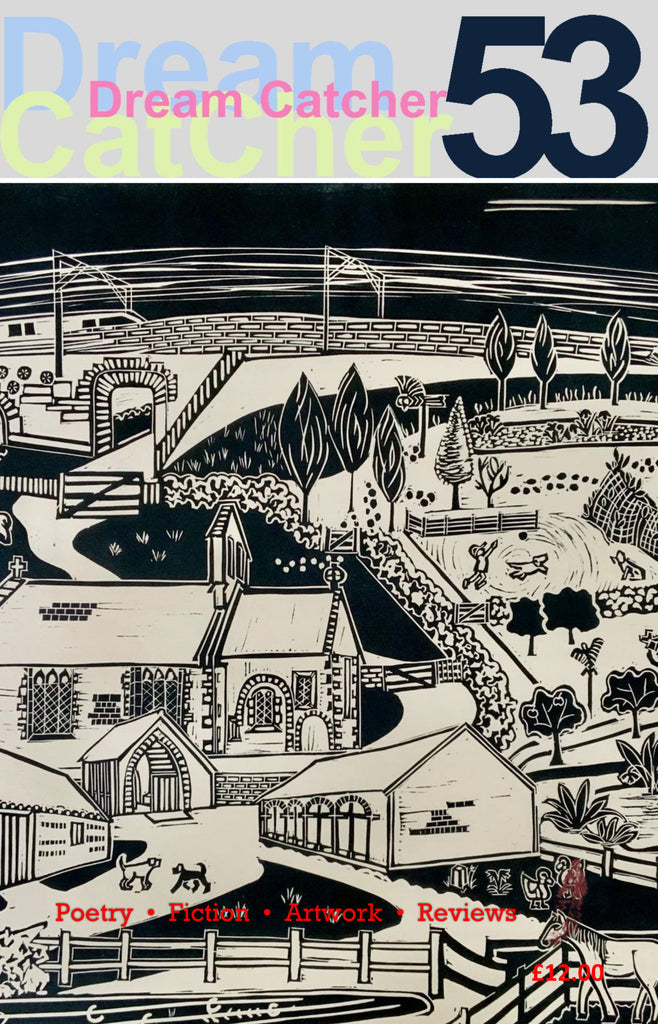
Drawing upon close observation, photography and a profound affection for place, Jo Rodwell's linocuts celebrate her chosen city of York through richly detailed panoramas that map the city's architecture, history and everyday life. Her prints transform landmarks and overlooked corners alike into interconnected visual narratives, where ancient walls, winding streets, public gardens and modern developments coexist within a single imaginative landscape. Through the distinctive language of relief printmaking, Rodwell creates works that are both records of place and acts of storytelling.

York has long been described as a city layered with history, and Rodwell's linocuts embrace that complexity. Rather than presenting a single viewpoint, her compositions unfold as visual journeys, weaving together multiple locations, perspectives and moments in time. Medieval gateways lead towards contemporary cultural spaces; rivers and roads curve through scenes populated by local characters; public parks, monuments and civic buildings emerge as interconnected threads within the wider fabric of the city. The result is not a literal map, but something more evocative: a portrait of a city as it is experienced, remembered and lived, a vision which pertains to a poetic experience of seemingly linear episodes:
"a poem is a city filled with streets and sewers
filled with saints, heroes, beggars, madmen,
filled with banality and booze,
filled with rain and thunder and periods of
drought, a poem is a city at war,
a poem is a city asking a clock why,"
— a poem is a city by Charles Bukowski
The linocut process is particularly suited to Rodwell's vision. Bold contrasts between ink and paper create images of stark clarity, while the carved line lends rhythm and movement to every scene. Buildings become patterns, streets become pathways, and landscapes unfold through a rich interplay of texture and design. The economy of the medium encourages a careful selection of detail, yet Rodwell's prints remain wonderfully abundant, rewarding repeated viewing with discoveries that might initially go unnoticed.

There is an unmistakable sense of joy within these works. Their intricate compositions encourage the eye to wander, turning a corner to encounter an unexpected view, a hidden garden or a fragment of the city's past. The prints celebrate not only celebrated landmarks such as York Minster and the city walls, but also the everyday spaces and local details that contribute to York's unique character. In doing so, they capture something of the city's enduring appeal: its ability to balance grandeur with intimacy, history with contemporary life.
The writer Rebecca Solnit has observed that, "A city is a language, a repository of possibilities." Rodwell's linocuts embrace those possibilities with imagination, precision and warmth. Each print acts as a visual conversation between artist and place, revealing York not as a static historic monument but as a vibrant, evolving environment shaped by memory, community and experience.

It is this combination of craftsmanship, curiosity and affection that gives Rodwell's work its distinctive power. Her linocuts are not merely depictions of York but celebrations of it, inviting viewers to trace familiar routes, discover new connections and experience the city through fresh eyes. Rich in detail yet unified by elegant design, they stand as both artistic achievements and enduring tributes experiencing heritage and modernity, all at once.